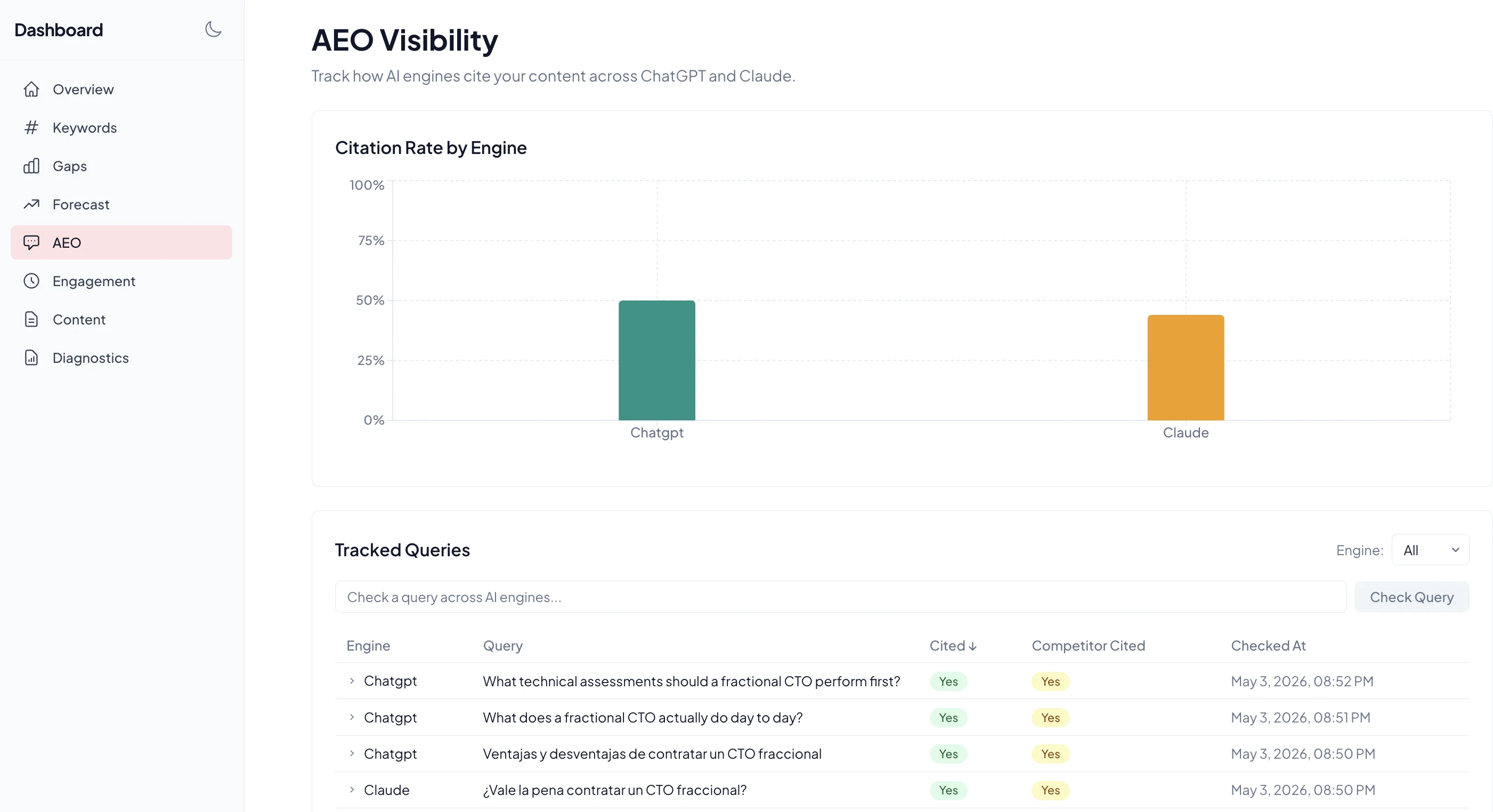
I tracked 5,000 citations that ChatGPT and Claude returned in response to 60 queries over 2.5 months. The two engines cited 452 different domains. The domains they prefer have almost nothing in common with each other, and little in common with what Google ranks for the same topic.
The queries here center on one professional services category (fractional CTOs — what I do for a living, which is why I had the data). The findings about specific domains are particular to this niche. The findings about how the engines behave are likely to generalize to any consulting or B2B services category where buyers ask AI engines for recommendations: what they cite, what they ignore, how their preferences diverge.
If you optimize for Google's SERP, you may not be visible in AI search. If you optimize for one AI engine, you probably aren't ranked in the other. AEO is three different surfaces stacked on top of each other.
Five things the data shows
1. AI search is fragmented in a way Google search isn't
The top 10 most-cited domains across ChatGPT and Claude account for 24.8% of all citations. The top 25 = 41.9%. The top 50 = 59.1%.
| Domain group | Share of all citations |
|---|---|
| Top 10 domains | 24.8% |
| Top 25 domains | 41.9% |
| Top 50 domains | 59.1% |
| All 452 domains | 100% |
For comparison, Google's top 10 for this niche's main search terms is more concentrated: the top 10 domains take 39.4% of listings, and Reddit alone takes 8.1%.
The two sides aren't asked the same things (short search terms on Google, full questions in AI), so part of that gap is the query mix. Still, there is no equivalent of "the Reddit thread that owns the SERP" in these AI answers. Every conversation pulls from a different mix.
Why it matters. Anyone trying to rank in AI search is competing against a long tail, not a wall of marketplace giants. Good news if you have specific, citable content.
2. ChatGPT and Claude don't cite Reddit here
Published research from Q1 2026 says Reddit is the single most-cited domain across major AI engines. The 5W AI Platform Citation Source Index attributes Reddit roughly 40% of all AI citations across ChatGPT, Gemini, Claude, Perplexity, and Google AI Overviews. Tinuiti's tracker, as summarized by SaaS Intelligence, reports Reddit's AI citation share grew 73% from October 2025 to January 2026. If you read AEO commentary, the message is consistent: Reddit is winning AI search.
Across the 5,000 citations in this dataset, Reddit appears 0 times: 0 of ChatGPT's 2,307 and 0 of Claude's 2,629.
Both numbers can be true at the same time. The Reddit-dominant numbers come from datasets that span consumer goods, shopping, product comparison, software, finance, and travel: categories where Reddit has high-engagement comparison threads. Azoma's per-query-type breakdown shows Reddit at 15% of ChatGPT's citations for shopping queries and 12% for general queries. Subreddits like r/BuyItForLife or r/headphones drive that volume.
The Reddit threads exist for this niche: Google ranks Reddit in its top 10 for almost every main search term here. ChatGPT and Claude just don't cite them. Otterly's Claude citation study later found Claude citing Reddit 0 times across categories, so for Claude this isn't about the niche at all.
| Query category | Reddit citation share | Source |
|---|---|---|
| Shopping / commerce (ChatGPT) | ~15% | Azoma 2026 |
| General queries (ChatGPT) | ~12% | Azoma 2026 |
| All categories, five engines | ~40% | 5W 2026 |
| Fractional CTO, ChatGPT and Claude | 0% | This study |
LinkedIn shows a similar but milder pattern in this dataset: 210 Google top-10 appearances on the main search terms, but only 24 AI citations. HackerNews barely registers anywhere. Both engines in this dataset overwhelmingly cite structured editorial content for B2B service queries: consultant blogs, marketplace explainers, agency websites.
Why it matters. The "Reddit is the most important AEO surface" advice depends on the engine. ChatGPT and Claude cited Reddit zero times here, even though Google ranks Reddit for the same topic. Before investing in Reddit seeding for AI visibility, check which engines your buyers actually use.
3. ChatGPT and Claude have radically different favorite sources
I expected modest variation between engines. The data shows something stronger.
Claude over-indexes on marketplaces and aggregators:
| Domain | Claude answers citing it | ChatGPT answers citing it |
|---|---|---|
| gofractional.com | 109 | 0 |
| fractionalctos.org | 63 | 1 |
| arc.dev | 56 | 0 |
| cto.academy | 42 | 0 |
| www.aikenhouse.com | 38 | 1 |
ChatGPT's lists are shorter and less distinctive. Its most ChatGPT-only source is my own Spanish site, ctofraccional.com (14 answers against Claude's 0), followed by keytotech.com (15 against 0, all on one question).
Counts are answers that cited the domain, over the questions both engines answered in the same run. Claude weights platforms with editorial or curatorial structure ("here are 10 fractional CTOs"): marketplaces, directories and training sites.
Why it matters. A page that wins Claude citations may not be the same page that wins ChatGPT citations. Different content forms map to different engine preferences. Optimizing for one isn't optimizing for both.
4. AI engines cite deep pages, not homepages
| URL type | ChatGPT | Claude |
|---|---|---|
| Articles and blog posts | 37.4% | 59.8% |
Service and landing pages (e.g. /service-x) | 38.3% | 21.3% |
| Other deep pages | 6.1% | 9.0% |
| Homepages | 18.2% | 9.9% |
About one ChatGPT link in five goes to a homepage, and one Claude link in ten. The rest point to specific articles, service pages, or pricing and methodology pages. Each URL counts in one category only.
The takeaway is the opposite of what most consultant websites are designed for. A homepage with a hero, services overview, and contact form gets a small share of AI citations. The pages that get cited are the ones that answer a specific question with structure: pricing breakdowns, role definitions, comparison frameworks, decision trees.
Why it matters. If your strongest content lives on the homepage and your "blog" is a thin afterthought, AI search will skip you. The deep content is the AI-search content.
5. ChatGPT tags every citation. Claude doesn't.
100% of ChatGPT citations in this dataset carried a utm_source parameter on the outbound URL (2,307 of 2,307). Zero Claude citations did.
The exact UTM value depends on which OpenAI product is sending the traffic. Consumer-facing ChatGPT (what most people use) tags outbound links with utm_source=chatgpt.com, a behavior rolled out broadly in June 2025. The OpenAI API with web search (the path I used for this study) tags with utm_source=openai instead. Different product, different value, same pattern: every ChatGPT-cited URL is attributable.
Claude does the opposite. It doesn't append UTMs, and independent analytics research found that it doesn't reliably send the HTTP Referer header on outbound clicks either. So some traffic from Claude conversations lands in your analytics as "Direct", with no source attribution at all. There's a pending feature request asking Anthropic to add UTM tags. Until that ships, standard analytics setups see only part of the traffic Claude sends.
What follows from this:
- ChatGPT traffic is attributable. Filter your analytics by
utm_source=chatgpt.com(orutm_source=openaifor API-driven traffic) for a clean view of which conversations are sending visitors. - Much of Claude's traffic looks like Direct traffic. It carries no UTM, and the Referer doesn't always arrive. If you see little Claude in your analytics, that doesn't mean no one's using it.
- The "AI traffic" numbers most marketers quote underestimate the total by an unknown but real amount, because they only count the ChatGPT portion that's tagged.
Why it matters. If you're sizing AI search as a channel based on what shows up in GA4, you're sizing roughly half the picture. To get closer to the truth, segment your "Direct" traffic by landing-page URL: traffic landing on a deep article or pricing page (not the homepage), with no Referer and no UTM, is your best proxy for Claude and other untagged engines.
A note on listicle queries
Of the 60 queries I tracked, the most-cited individual queries are the "best of" listicle prompts:
| Query | Total citations (2.5 months) |
|---|---|
| Who are the best fractional CTOs? | 484 |
| Fractional CTO services for startups | 469 |
| CTO as a service for small companies | 428 |
| How to hire a fractional CTO for a startup? | 425 |
| Best fractional CTO in Latin America | 420 |
| Fractional CTO cost and pricing | 414 |
These queries return long answers with many citations each, so they look attractive as targets. But the citation distribution within each query is highly fragmented.
For example, "Best fractional CTO for fintech startups?" was checked 10 times, 5 per engine. The 8 answers that came with sources cited 26 different domains, and no domain appeared in more than 5 of them.
There is no anchor source for "best fractional CTO" queries. The engines don't know who the best ones are, so they sample broadly. Listicle queries are easier to break into than they look. But getting cited once doesn't mean getting cited repeatedly.
The opposite pattern shows up on geographic queries with smaller, more defined ecosystems. For "Best fractional CTO in Latin America," three sources together account for ~30% of all citations:
| Top citation | Citations | Share |
|---|---|---|
| pangea.ai | 47 | 11% |
| builtin.com | 44 | 10% |
| netmidas.com | 40 | 10% |
LATAM has clear top-3 winners. Fintech doesn't. The lesson: defined niches with fewer credible sources are more concentrable than open-ended categories with thousands of candidates.
Methodology
- Time range: February 27 to May 3, 2026 (66 days).
- Engines: ChatGPT (
gpt-4owith web search) and Claude (claude-sonnet-4-5, one web search per answer), queried via API with each prompt as a fresh conversation. ChatGPT ran with the instruction "Always search the web before answering. Cite your sources."; Claude had no system prompt. - Queries: 60 distinct prompts in English (39) and Spanish (21), covering definition queries, pricing queries, hire/process queries, best-of/comparison queries, and conversational long-tail.
- Cadence: Each query checked roughly weekly per engine. Top-volume English queries were checked up to 24 times; newer or lower-priority queries 5–7 times.
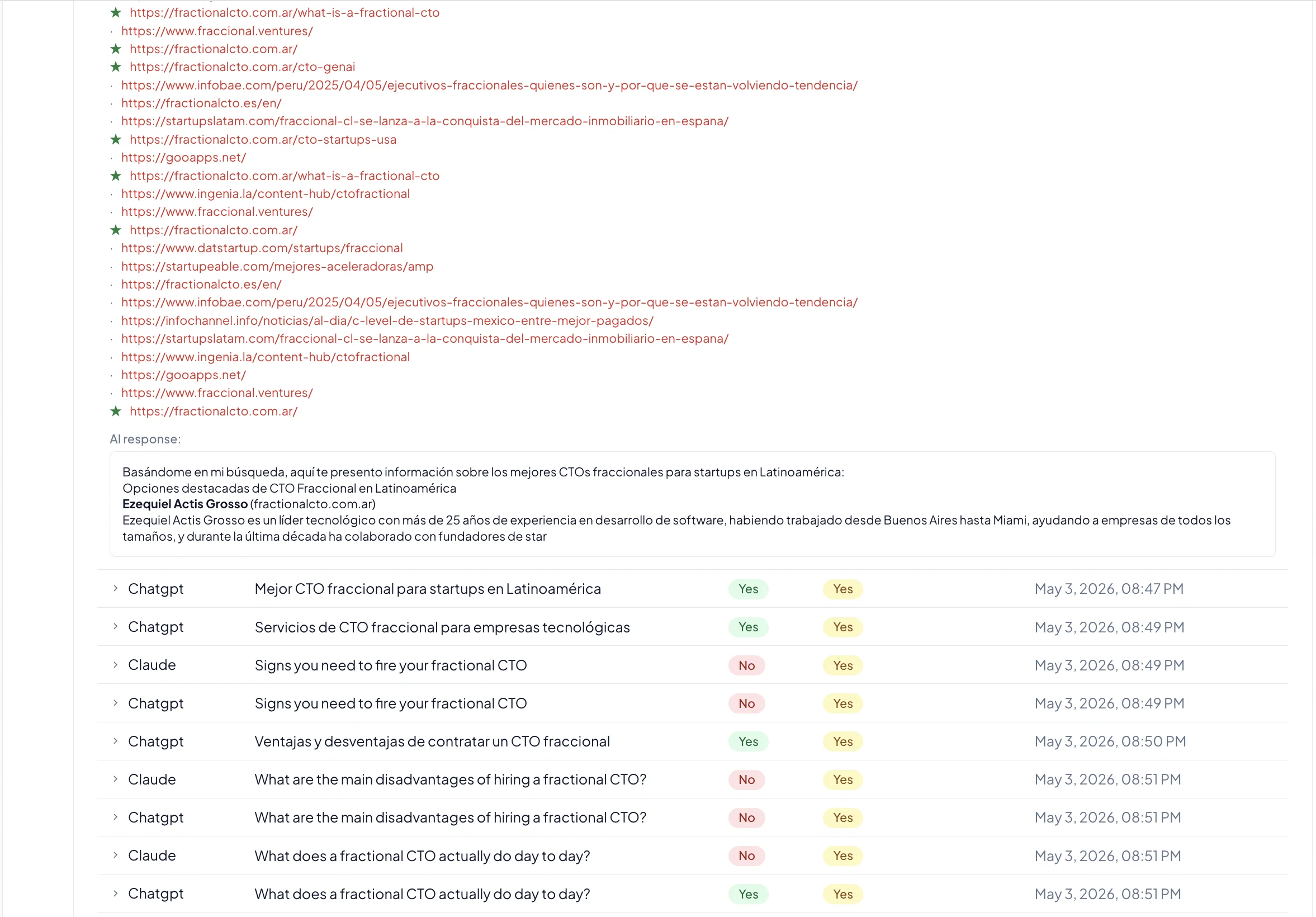
- Citation extraction: URLs parsed from each engine's structured response. Both engines provide source URLs alongside their answers.
Caveats:
- 60 queries is a curated set, not the full universe of fractional-CTO questions. Results bias toward the kinds of questions a US/LATAM startup founder might ask.
- Both engines were asked all 60 queries. Claude chose not to search on 19 of them, so its citations come from 41.
- The queries are my own market: I sell fractional CTO services, and my sites (fractionalcto.com.ar and ctofraccional.com) are in the data, with 257 citations, 5.2% of the total.
- The citations come from API responses. They aren't clicks, and the consumer apps may cite differently.
- The Google comparison uses this niche's 13 main search terms on US Google, not the same 60 questions.
- The query set grew from 33 to 58 questions in late April, which shifts the weekly patterns around that date.
- Both engines occasionally cite search engines or aggregator metadata pages, and ChatGPT sometimes attaches Google Maps links to the firms it names. I did not filter these out.
The full dataset is available as a CSV (4,936 rows, one per citation): timestamp, engine, query, language, cited URL, domain, and whether the domain is one of mine.
What this means if you're trying to be cited
- Don't over-optimize for one engine. The Claude playbook and the ChatGPT playbook are different enough that aiming at one will likely miss the other. Pick the engine whose audience matters more to you, and accept the trade-off.
- Build deep pages, not homepages. The single-homepage / many-shallow-pages pattern most consultant sites use is invisible to AI search. Pricing pages, methodology pages, role-definition pages, comparison tables: that's what gets cited.
- Pick a defined niche. "Best fractional CTO for fintech" has 26 winners. "Best fractional CTO in [defined region or vertical]" has 3 to 5. The narrower category is the easier one to win.
- Tag your own analytics. Filter for
utm_source=chatgpt.com(consumer ChatGPT) andutm_source=openai(API-driven). Segment "Direct" traffic by landings on deep article and pricing pages, which is your best proxy for Claude and other untagged engines. Treat them as separate channels. - Check whether Reddit works for your engines before chasing it. Published research shows Reddit dominating AI citations in consumer categories, but ChatGPT and Claude cited it zero times in this dataset, while Google ranks it for the same topic.
Open questions
A few things this data doesn't answer that I'd like to track in the next quarter:
- How quickly do new pages get indexed by AI engines? I launched a pricing page on April 30 and have not yet seen it cited.
- Does
sitemap.xmlaffect AI citation, or do these engines crawl independently? - Do
llms.txtfiles influence citations yet? Adoption is too small in this dataset to tell. - Is there citation persistence? When a domain wins a slot, does it keep winning, or does each run sample fresh? Early evidence points both ways.
The seven-month follow-up adds Gemini and Perplexity and covers February to September 2026.
About this report
This data comes from an SEO/AEO monitoring agent I built to track my own visibility across Google and AI engines. I'm publishing it because I couldn't find cross-engine citation data for B2B services, and the gap between common AEO advice and what the data shows is wider than I expected.
Questions, corrections, or requests for additional cuts: connect on LinkedIn.